With gas prices creeping higher, fuel economy is more relevant than ever. Every new car comes with a sticker promising a certain number of miles per gallon, followed by “your mileage may vary” in fine print. Standard emissions tests can never simulate all driving conditions, including the lead foot who drives uphill with the brakes on. They advertise the average, but everyone’s route and habits will lead to a slightly different experience.
The third quarter’s “sticker numbers” looked impressive in aggregate, but with consumer sentiment near its lowest level in years, it’s clear that everyone’s mileage varies. How do we frame the disconnect we’re seeing, and how do we navigate the route ahead?
A strong economy that doesn’t always feel strong
The economy looks healthy on paper. Consumer and business demand has remained resilient, corporate profit margins are near record levels, and estimates suggest the economy continued to grow at a strong pace during the third quarter.
Yet ask households how they feel, and you get a different answer. Consumer sentiment remains near historic lows, while survey measures of inflation expectations have moved higher. We see four fairly straightforward reasons for this puzzling disconnect.
Slow jobs growth. First, much of today’s growth is happening in places that do not immediately translate into more jobs or higher wages. Investment in artificial intelligence, data centers, semiconductors and software has been extraordinary. While it is showing up clearly in corporate profits and stock prices, it is less obvious in the everyday experience of many workers. That does not make the investment unimportant, but building a data center or buying advanced computer chips can add to economic growth without creating the kind of broad-based hiring boom that consumers notice right away.
Inflation hits differently. Second, households experience inflation differently than economists do. The Federal Reserve spends a great deal of time looking at measures of “core” inflation that exclude volatile food and energy prices. There are good reasons for doing that, but families cannot exclude those things from their budgets. The increase in energy prices this year has been especially noticeable, with gasoline prices up sharply through August, and heating oil rising even more. An improvement in core inflation offers little comfort to someone standing at the gas pump.
Consumer shifts. Third, consumers are still spending, though the drivers of that spending may be shifting. Wage growth has slowed, hiring has cooled, and after adjusting for inflation, household income has made limited progress. Spending, however, has remained surprisingly strong. One possible explanation is what economists call the ‘wealth effect,’ where households, particularly those who own financial assets, tend to spend more when their balance sheets are healthy. Stock portfolios are near record highs, and the personal saving rate is low. Together, these suggest that some Americans may be drawing on wealth they accumulated over the past several years. That could support the economy for some time, but it would be different from an economy driven by rapidly rising paychecks.
Averages. Finally, averages can hide very different experiences. Higher stock prices and corporate profits disproportionately benefit households that already own assets. Higher grocery, gasoline and utility bills are felt by nearly everyone. Two things can be true at the same time: the economy can be doing well overall, while many families feel that their own finances remain under pressure.
Over time, we hope this gap will narrow. Energy prices could ease, AI-related investment could begin producing broader productivity gains and higher incomes, or both could happen. In the meantime, it is worth remembering that consumer pessimism and investment returns do not always move together.
The quarter in review: calm stocks, much less calm bonds
Stocks finished the quarter close to record highs. Beneath the surface, however, there was considerably more movement.
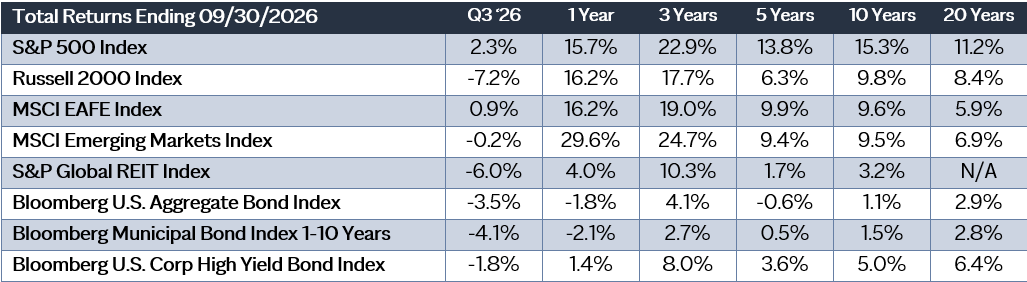
The returns shown are annualized returns, except for periods less than one year, for the selected asset classes as represented by benchmark indices. Investors cannot invest directly in an index. Unmanaged indices do not reflect management fees or transaction costs. Past performance is not guarantee of future results. Source: Ycharts. See full disclosures.
Stocks: Strong earnings, but fewer companies are doing the heavy lifting
Corporate profits continued to grow, which helped support equity markets. But they became increasingly dependent on a relatively small group of companies and industries, particularly energy and businesses tied to AI infrastructure. Smaller companies and more interest-rate-sensitive parts of the equity markets had a more difficult quarter.
We do not view that as a reason to abandon equities, though we do think it is a reason to be selective. When performance differs this much across industries and companies, quality matters. Strong balance sheets, durable earnings, and reasonable valuations become more important than simply owning whatever has risen the most.
Bonds: Higher yields create pain today and opportunity tomorrow
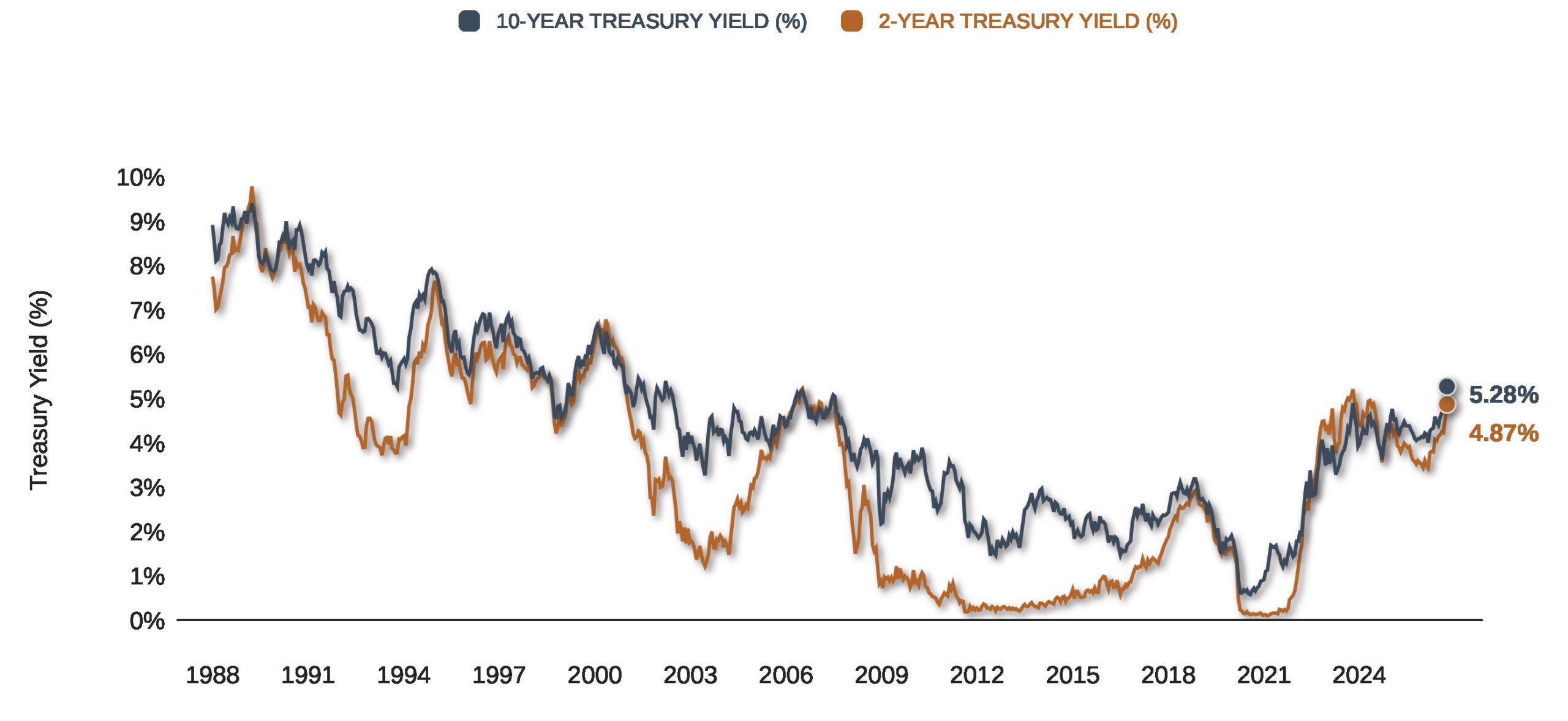
The 10-year Treasury yield moved above 5% during the quarter. Interestingly, that rise was not primarily because investors suddenly became much more worried about inflation, as long-term inflation expectations remained relatively stable. Instead, investors demanded a higher return for lending money for long periods of time. There are several reasons for that, including heavy Treasury borrowing, less enthusiastic demand from some overseas buyers, and higher interest rates in other parts of the world.
For investors who already owned long-term bonds, rising yields meant lower prices. But higher yields have also improved the income outlook for bond investors overall. After more than a decade following the Global Financial Crisis and the pandemic in which interest rates were near zero and conservative investments paid very little, bonds are once again contributing income rather than simply serving as portfolio ballast. That is one of the most important changes in the investment landscape.
Credit: AI meets the bond market
The enormous amount of spending on AI infrastructure is increasingly being financed through the bond market. Large technology companies have issued hundreds of billions of dollars of debt to fund data centers and related investment. Investors are still willing to provide that capital, but they are becoming more selective.
We view that as healthy. Higher interest rates force companies to prove that projects can earn attractive returns. Cheap money can finance both great ideas and bad ones; more expensive money tends to separate the two. We remain enthusiastic about the long-term potential of AI, but enthusiasm for a new technology is not the same thing as believing every investment made in its name will succeed.
Inflation: Better news, but not an all-clear
The quarter ended with an important revision to the inflation data. Core inflation now appears to have been somewhat lower than previously reported, and the most recent readings are moving closer to the Federal Reserve’s long-term goal. That is encouraging. At the same time, energy prices remain unpredictable and services inflation is still firm. As a result, we believe it is still too soon to conclude that inflation pressures have fully subsided.
What is striking is the difference between how consumers and financial markets see the outlook. Households expect inflation to remain relatively high, while bond-market pricing suggests investors expect inflation to move back toward more normal levels over time. That tension is one of the key issues we will be watching in the months ahead.
Three Themes to Watch in the Fourth Quarter
1. Income is back, impacting portfolio construction
For years, investors faced an uncomfortable choice: accept very low returns from bonds and cash or take more risk in stocks and other investments in search of higher returns. That tradeoff has changed.
Consider a simple example. A $1 million investment in 10-year Treasury bonds might have generated roughly $15,000 of annual interest in 2021. At today’s yields, the same investment could generate more than $50,000. That is a meaningful difference. For investors willing to take modest additional credit risk, investment-grade corporate bonds may offer still more income. For investors in higher tax brackets, municipal bonds also may offer attractive tax-free income.
This matters particularly for retirees and others who draw income from their portfolios. Higher bond yields may allow investors to meet cash flow needs more comfortably, without relying heavily on asset sales or stretching for return elsewhere in the portfolio. They also improve the opportunity set within fixed income. If inflation continues to ease and interest rates eventually decline, existing bond holdings may benefit from rising prices. If rates move higher, bond portfolios can gradually adjust as proceeds and principal are reinvested at those higher yields. In either case, investors do not need to predict the precise path of rates to benefit from a bond market that once again provides income.
A Long-Term View of U.S. Treasury Yields
2- Year and 10-Year U.S. Treasury Yields Over the Long-Term
Source: © Exhibit A, FactSet Research Systems Inc. | Latest: 2026-09-30
This slide is for informational and illustrative purposes only. The data provided is believed to be accurate, but there is no guarantee of its accuracy, completeness, or timeliness. This is not a recommendation or offer of any financial product. Past performance is not indicative of future results, and investors should consider their own objectives and risk tolerance. Indices, if presented, do not include fees, are unmanaged, and not available for direct investment. Definitions & Methodology: The 10-Year Treasury Yield measures the return on U.S. Treasury bonds maturing in ten years, frequently used as a benchmark for long-term interest rates and a gauge of economic growth expectations. The 2-Year Treasury Yield measures the return on U.S. Treasury bonds maturing in two years, often used as an indicator of short-term interest rates and market expectations for economic conditions. The chart shows the path of both the 2-year and 10-year treasury yields since 1988.
2. Good investment opportunities are not limited to the United States
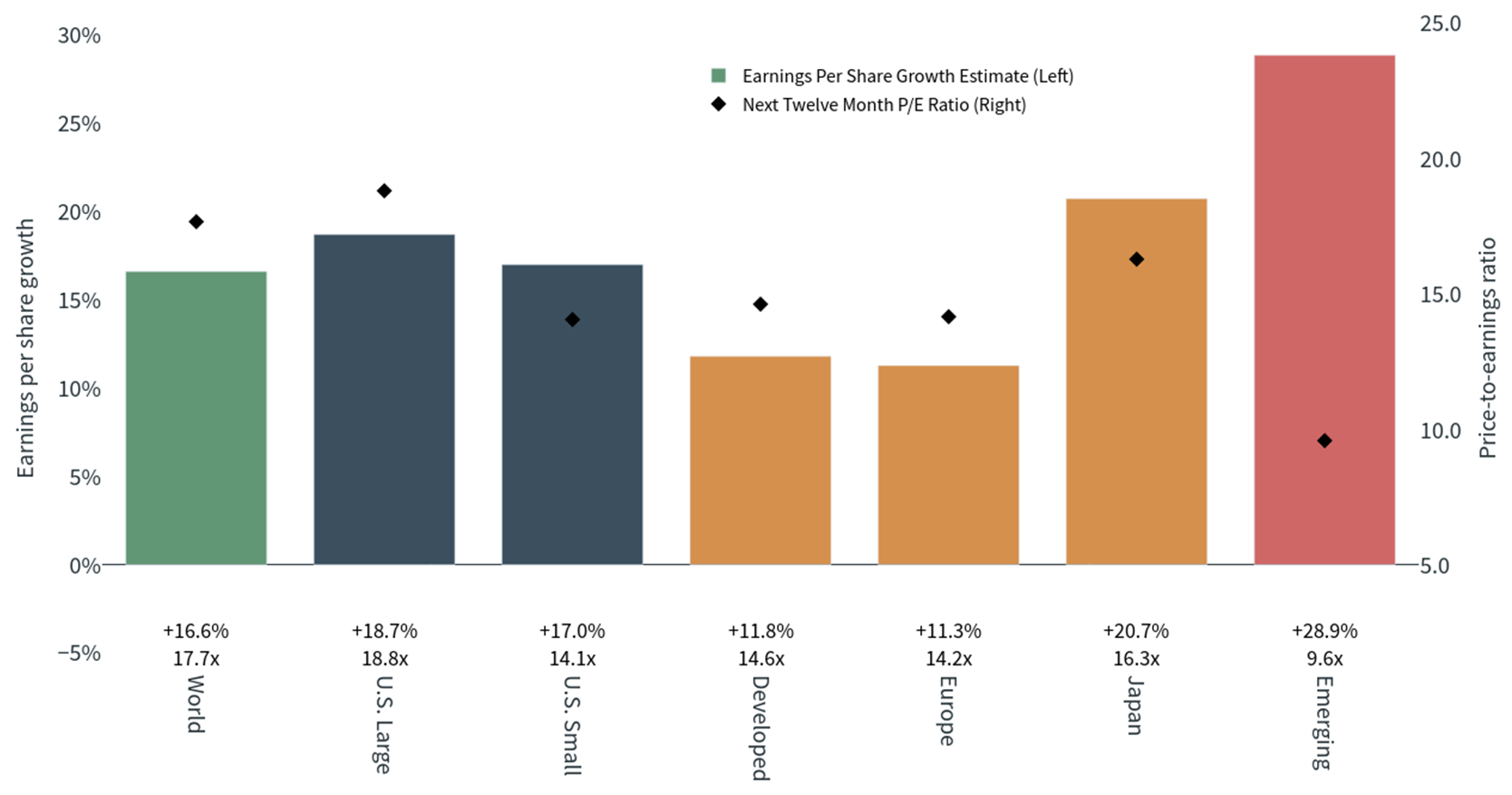
American companies have continued to report solid earnings, and this year earnings growth has broadened beyond the U.S., with results improving in Japan, parts of Europe and several emerging markets. In Korea and Taiwan, much of that improvement has been tied to demand for AI-related technology, especially semiconductors.
This matters for two reasons. First, rising profits provide a healthier foundation for stock prices than simply hoping investors will pay ever-higher valuations. Second, many international markets remain considerably less expensive than the U.S. market.
For much of the past decade, concentrating in large U.S. companies was rewarded. That experience can make diversification feel unnecessary just when it is becoming more valuable. We continue to believe that the United States should represent a significant portion of most equity portfolios. But we also believe investors should own companies outside the U.S.
The next earnings season will tell us whether this broadening continues. We will be paying particular attention to 2027 forecasts, the impact of the stronger dollar, and whether profit growth spreads beyond technology, semiconductors and financials.
Global Earnings and Valuations
Earnings Growth and P/E Ratios, Next Twelve Month Estimates
Sources: Clearnomics, MSCI, Standard & Poor’s, LSEG
© 2026 Clearnomics, Inc.
3. Build a portfolio for the direction of travel, not every turn in the road
There is no shortage of things investors could worry about. We do not know what will happen next in the Strait of Hormuz. We do not know exactly when the Federal Reserve will change rates again. We do not know how the midterm elections will affect taxes, tariffs, or government spending. And we certainly do not know how quickly today’s extraordinary spending on AI will turn into tomorrow’s profits.
Fortunately, investors don’t need to answer all those questions correctly for a portfolio to remain on sound footing. A well-constructed portfolio should be able to withstand some surprises.
That is why our approach for the quarter ahead is intentionally straightforward. Within each portfolio as appropriate, we strive to:
- Invest in bonds providing more income than they have in years.
- Own equities across different industries, investment styles and geographies.
- Maintain exposure to assets that can help if inflation or energy prices surprise us.
- Rebalance portfolios when markets give us the opportunity, adding to investments that have become less expensive and trimming those that have run ahead.
While that may not sound particularly exciting, prudent investing should not require making a heroic forecast every three months.
The Road Ahead
Strong economic growth and weak consumer confidence can coexist for longer than most of us expect. We do not need to predict exactly when that gap will close to invest effectively.
For us, the most important change in the investment landscape is the return of interest rates as a meaningful force in the economy and in portfolios. They affect what the government pays to borrow, which corporate projects make economic sense, and how much a homebuyer can afford, as well as what investors can earn from the conservative portion of a portfolio.
That creates challenges, but it also creates opportunities we have not had in many years. Rather than building portfolios that depend on rates falling quickly, we prefer portfolios that can benefit while we wait: bonds generating income, equities participating in long-term growth, and diversification providing resilience when our forecasts inevitably prove imperfect.
Your mileage will still vary, but you do not need perfect road conditions to reach your destination. You need a sensible route, a sound vehicle, and the patience not to change lanes every time traffic slows.
As always, we welcome your questions, feedback, and engagement. Thank you for entrusting us with your financial roadmap.
YCharts ©2025 YCharts, Inc. All rights reserved. The information contained herein: (1) is proprietary to YCharts, Inc. and/or its content providers; (2) may not be copied, reproduced, retransmitted, or distributed; and (3) is provided AS IS with all faults and is not warranted to be accurate, complete, or timely. YCHARTS, INC. AND ITS CONTENT PROVIDERS EXPRESSLY DISCLAIM, TO THE FULLEST EXTENT PERMITTED BY APPLICABLE LAW, ANY WARRANTY OF ANY KIND, WHETHER EXPRESS OR IMPLIED, INCLUDING WARRANTIES OF MERCHANTABILITY, FITNESS FOR A PARTICULAR PURPOSE, ACCURACY OF INFORMATIONAL CONTENT, OR ANY IMPLIED WARRANTIES ARISING OUT OF COURSE OF DEALING OR COURSE OF PERFORMANCE. Neither YCharts, Inc. nor its content providers are responsible for any damages or losses arising from the use of this information. Past performance is no guarantee of future results. YCharts, Inc. (YCharts) is not registered with the U.S. Securities and Exchange Commission (or with the securities regulatory authority or body of any state or any other jurisdiction) as an investment adviser, broker-dealer or in any other capacity, and does not purport to provide investment advice or make investment recommendations. This report has been generated through the application of the analytical tools and data provided through ycharts.com and is intended solely to assist you or your investment or other adviser(s) in conducting investment research. You should not construe this report as an offer to buy or sell, as a solicitation of an offer to buy or sell, or as a recommendation to buy, sell, hold or trade, any security or other financial instrument. For further information regarding your use of this report, please go to: ycharts.com/about/disclosure.
Copyright (c) 2025 Clearnomics, Inc. All rights reserved. The information contained herein has been obtained from sources believed to be reliable, but is not necessarily complete and its accuracy cannot be guaranteed. No representation or warranty, express or implied, is made as to the fairness, accuracy, completeness, or correctness of the information and opinions contained herein. The views and the other information provided are subject to change without notice. All reports posted on or via www.clearnomics.com or any affiliated websites, applications, or services are issued without regard to the specific investment objectives, financial situation, or particular needs of any specific recipient and are not to be construed as a solicitation or an offer to buy or sell any securities or related financial instruments. Past performance is not necessarily a guide to future results. Company fundamentals and earnings may be mentioned occasionally, but should not be construed as a recommendation to buy, sell, or hold the company’s stock. Predictions, forecasts, and estimates for any and all markets should not be construed as recommendations to buy, sell, or hold any security–including mutual funds, futures contracts, and exchange traded funds, or any similar instruments. The text, images, and other materials contained or displayed in this report are proprietary to Clearnomics, Inc. and constitute valuable intellectual property. All unauthorized reproduction or other use of material from Clearnomics, Inc. shall be deemed willful infringement(s) of this copyright and other proprietary and intellectual property rights, including but not limited to, rights of privacy. Clearnomics, Inc. expressly reserves all rights in connection with its intellectual property, including without limitation the right to block the transfer of its products and services and/or to track usage thereof, through electronic tracking technology, and all other lawful means, now known or hereafter devised. Clearnomics, Inc. reserves the right, without further notice, to pursue to the fullest extent allowed by the law any and all criminal and civil remedies for the violation of its rights.
Bloomberg data provided by Bloomberg. Frank Russell Company is the source and owner of the trademarks, service marks, and copyrights related to the FTSE and Russell Indexes. MSCI data © MSCI 2025, all rights reserved. S&P data © 2025 S&P Dow Jones Indices LLC, a division of S&P Global. All rights reserved.


Investment Commentary: Q3 2026
Gaurav Mallik,
Chief Investment Officer
Your Mileage May Vary
With gas prices creeping higher, fuel economy is more relevant than ever. Every new car comes with a sticker promising a certain number of miles per gallon, followed by “your mileage may vary” in fine print. Standard emissions tests can never simulate all driving conditions, including the lead foot who drives uphill with the brakes on. They advertise the average, but everyone’s route and habits will lead to a slightly different experience.
The third quarter’s “sticker numbers” looked impressive in aggregate, but with consumer sentiment near its lowest level in years, it’s clear that everyone’s mileage varies. How do we frame the disconnect we’re seeing, and how do we navigate the route ahead?
A strong economy that doesn’t always feel strong
The economy looks healthy on paper. Consumer and business demand has remained resilient, corporate profit margins are near record levels, and estimates suggest the economy continued to grow at a strong pace during the third quarter.
Yet ask households how they feel, and you get a different answer. Consumer sentiment remains near historic lows, while survey measures of inflation expectations have moved higher. We see four fairly straightforward reasons for this puzzling disconnect.
Slow jobs growth. First, much of today’s growth is happening in places that do not immediately translate into more jobs or higher wages. Investment in artificial intelligence, data centers, semiconductors and software has been extraordinary. While it is showing up clearly in corporate profits and stock prices, it is less obvious in the everyday experience of many workers. That does not make the investment unimportant, but building a data center or buying advanced computer chips can add to economic growth without creating the kind of broad-based hiring boom that consumers notice right away.
Inflation hits differently. Second, households experience inflation differently than economists do. The Federal Reserve spends a great deal of time looking at measures of “core” inflation that exclude volatile food and energy prices. There are good reasons for doing that, but families cannot exclude those things from their budgets. The increase in energy prices this year has been especially noticeable, with gasoline prices up sharply through August, and heating oil rising even more. An improvement in core inflation offers little comfort to someone standing at the gas pump.
Consumer shifts. Third, consumers are still spending, though the drivers of that spending may be shifting. Wage growth has slowed, hiring has cooled, and after adjusting for inflation, household income has made limited progress. Spending, however, has remained surprisingly strong. One possible explanation is what economists call the ‘wealth effect,’ where households, particularly those who own financial assets, tend to spend more when their balance sheets are healthy. Stock portfolios are near record highs, and the personal saving rate is low. Together, these suggest that some Americans may be drawing on wealth they accumulated over the past several years. That could support the economy for some time, but it would be different from an economy driven by rapidly rising paychecks.
Averages. Finally, averages can hide very different experiences. Higher stock prices and corporate profits disproportionately benefit households that already own assets. Higher grocery, gasoline and utility bills are felt by nearly everyone. Two things can be true at the same time: the economy can be doing well overall, while many families feel that their own finances remain under pressure.
Over time, we hope this gap will narrow. Energy prices could ease, AI-related investment could begin producing broader productivity gains and higher incomes, or both could happen. In the meantime, it is worth remembering that consumer pessimism and investment returns do not always move together.
The quarter in review: calm stocks, much less calm bonds
Stocks finished the quarter close to record highs. Beneath the surface, however, there was considerably more movement.
The returns shown are annualized returns, except for periods less than one year, for the selected asset classes as represented by benchmark indices. Investors cannot invest directly in an index. Unmanaged indices do not reflect management fees or transaction costs. Past performance is not guarantee of future results. Source: Ycharts. See full disclosures.
Stocks: Strong earnings, but fewer companies are doing the heavy lifting
Corporate profits continued to grow, which helped support equity markets. But they became increasingly dependent on a relatively small group of companies and industries, particularly energy and businesses tied to AI infrastructure. Smaller companies and more interest-rate-sensitive parts of the equity markets had a more difficult quarter.
We do not view that as a reason to abandon equities, though we do think it is a reason to be selective. When performance differs this much across industries and companies, quality matters. Strong balance sheets, durable earnings, and reasonable valuations become more important than simply owning whatever has risen the most.
Bonds: Higher yields create pain today and opportunity tomorrow
The 10-year Treasury yield moved above 5% during the quarter. Interestingly, that rise was not primarily because investors suddenly became much more worried about inflation, as long-term inflation expectations remained relatively stable. Instead, investors demanded a higher return for lending money for long periods of time. There are several reasons for that, including heavy Treasury borrowing, less enthusiastic demand from some overseas buyers, and higher interest rates in other parts of the world.
For investors who already owned long-term bonds, rising yields meant lower prices. But higher yields have also improved the income outlook for bond investors overall. After more than a decade following the Global Financial Crisis and the pandemic in which interest rates were near zero and conservative investments paid very little, bonds are once again contributing income rather than simply serving as portfolio ballast. That is one of the most important changes in the investment landscape.
Credit: AI meets the bond market
The enormous amount of spending on AI infrastructure is increasingly being financed through the bond market. Large technology companies have issued hundreds of billions of dollars of debt to fund data centers and related investment. Investors are still willing to provide that capital, but they are becoming more selective.
We view that as healthy. Higher interest rates force companies to prove that projects can earn attractive returns. Cheap money can finance both great ideas and bad ones; more expensive money tends to separate the two. We remain enthusiastic about the long-term potential of AI, but enthusiasm for a new technology is not the same thing as believing every investment made in its name will succeed.
Inflation: Better news, but not an all-clear
The quarter ended with an important revision to the inflation data. Core inflation now appears to have been somewhat lower than previously reported, and the most recent readings are moving closer to the Federal Reserve’s long-term goal. That is encouraging. At the same time, energy prices remain unpredictable and services inflation is still firm. As a result, we believe it is still too soon to conclude that inflation pressures have fully subsided.
What is striking is the difference between how consumers and financial markets see the outlook. Households expect inflation to remain relatively high, while bond-market pricing suggests investors expect inflation to move back toward more normal levels over time. That tension is one of the key issues we will be watching in the months ahead.
Three Themes to Watch in the Fourth Quarter
1. Income is back, impacting portfolio construction
For years, investors faced an uncomfortable choice: accept very low returns from bonds and cash or take more risk in stocks and other investments in search of higher returns. That tradeoff has changed.
Consider a simple example. A $1 million investment in 10-year Treasury bonds might have generated roughly $15,000 of annual interest in 2021. At today’s yields, the same investment could generate more than $50,000. That is a meaningful difference. For investors willing to take modest additional credit risk, investment-grade corporate bonds may offer still more income. For investors in higher tax brackets, municipal bonds also may offer attractive tax-free income.
This matters particularly for retirees and others who draw income from their portfolios. Higher bond yields may allow investors to meet cash flow needs more comfortably, without relying heavily on asset sales or stretching for return elsewhere in the portfolio. They also improve the opportunity set within fixed income. If inflation continues to ease and interest rates eventually decline, existing bond holdings may benefit from rising prices. If rates move higher, bond portfolios can gradually adjust as proceeds and principal are reinvested at those higher yields. In either case, investors do not need to predict the precise path of rates to benefit from a bond market that once again provides income.
A Long-Term View of U.S. Treasury Yields
2- Year and 10-Year U.S. Treasury Yields Over the Long-Term
Source: © Exhibit A, FactSet Research Systems Inc. | Latest: 2026-09-30
This slide is for informational and illustrative purposes only. The data provided is believed to be accurate, but there is no guarantee of its accuracy, completeness, or timeliness. This is not a recommendation or offer of any financial product. Past performance is not indicative of future results, and investors should consider their own objectives and risk tolerance. Indices, if presented, do not include fees, are unmanaged, and not available for direct investment. Definitions & Methodology: The 10-Year Treasury Yield measures the return on U.S. Treasury bonds maturing in ten years, frequently used as a benchmark for long-term interest rates and a gauge of economic growth expectations. The 2-Year Treasury Yield measures the return on U.S. Treasury bonds maturing in two years, often used as an indicator of short-term interest rates and market expectations for economic conditions. The chart shows the path of both the 2-year and 10-year treasury yields since 1988.
2. Good investment opportunities are not limited to the United States
American companies have continued to report solid earnings, and this year earnings growth has broadened beyond the U.S., with results improving in Japan, parts of Europe and several emerging markets. In Korea and Taiwan, much of that improvement has been tied to demand for AI-related technology, especially semiconductors.
This matters for two reasons. First, rising profits provide a healthier foundation for stock prices than simply hoping investors will pay ever-higher valuations. Second, many international markets remain considerably less expensive than the U.S. market.
For much of the past decade, concentrating in large U.S. companies was rewarded. That experience can make diversification feel unnecessary just when it is becoming more valuable. We continue to believe that the United States should represent a significant portion of most equity portfolios. But we also believe investors should own companies outside the U.S.
The next earnings season will tell us whether this broadening continues. We will be paying particular attention to 2027 forecasts, the impact of the stronger dollar, and whether profit growth spreads beyond technology, semiconductors and financials.
Global Earnings and Valuations
Earnings Growth and P/E Ratios, Next Twelve Month Estimates
Sources: Clearnomics, MSCI, Standard & Poor’s, LSEG
© 2026 Clearnomics, Inc.
3. Build a portfolio for the direction of travel, not every turn in the road
There is no shortage of things investors could worry about. We do not know what will happen next in the Strait of Hormuz. We do not know exactly when the Federal Reserve will change rates again. We do not know how the midterm elections will affect taxes, tariffs, or government spending. And we certainly do not know how quickly today’s extraordinary spending on AI will turn into tomorrow’s profits.
Fortunately, investors don’t need to answer all those questions correctly for a portfolio to remain on sound footing. A well-constructed portfolio should be able to withstand some surprises.
That is why our approach for the quarter ahead is intentionally straightforward. Within each portfolio as appropriate, we strive to:
While that may not sound particularly exciting, prudent investing should not require making a heroic forecast every three months.
The Road Ahead
Strong economic growth and weak consumer confidence can coexist for longer than most of us expect. We do not need to predict exactly when that gap will close to invest effectively.
For us, the most important change in the investment landscape is the return of interest rates as a meaningful force in the economy and in portfolios. They affect what the government pays to borrow, which corporate projects make economic sense, and how much a homebuyer can afford, as well as what investors can earn from the conservative portion of a portfolio.
That creates challenges, but it also creates opportunities we have not had in many years. Rather than building portfolios that depend on rates falling quickly, we prefer portfolios that can benefit while we wait: bonds generating income, equities participating in long-term growth, and diversification providing resilience when our forecasts inevitably prove imperfect.
Your mileage will still vary, but you do not need perfect road conditions to reach your destination. You need a sensible route, a sound vehicle, and the patience not to change lanes every time traffic slows.
As always, we welcome your questions, feedback, and engagement. Thank you for entrusting us with your financial roadmap.
YCharts ©2025 YCharts, Inc. All rights reserved. The information contained herein: (1) is proprietary to YCharts, Inc. and/or its content providers; (2) may not be copied, reproduced, retransmitted, or distributed; and (3) is provided AS IS with all faults and is not warranted to be accurate, complete, or timely. YCHARTS, INC. AND ITS CONTENT PROVIDERS EXPRESSLY DISCLAIM, TO THE FULLEST EXTENT PERMITTED BY APPLICABLE LAW, ANY WARRANTY OF ANY KIND, WHETHER EXPRESS OR IMPLIED, INCLUDING WARRANTIES OF MERCHANTABILITY, FITNESS FOR A PARTICULAR PURPOSE, ACCURACY OF INFORMATIONAL CONTENT, OR ANY IMPLIED WARRANTIES ARISING OUT OF COURSE OF DEALING OR COURSE OF PERFORMANCE. Neither YCharts, Inc. nor its content providers are responsible for any damages or losses arising from the use of this information. Past performance is no guarantee of future results. YCharts, Inc. (YCharts) is not registered with the U.S. Securities and Exchange Commission (or with the securities regulatory authority or body of any state or any other jurisdiction) as an investment adviser, broker-dealer or in any other capacity, and does not purport to provide investment advice or make investment recommendations. This report has been generated through the application of the analytical tools and data provided through ycharts.com and is intended solely to assist you or your investment or other adviser(s) in conducting investment research. You should not construe this report as an offer to buy or sell, as a solicitation of an offer to buy or sell, or as a recommendation to buy, sell, hold or trade, any security or other financial instrument. For further information regarding your use of this report, please go to: ycharts.com/about/disclosure.
Copyright (c) 2025 Clearnomics, Inc. All rights reserved. The information contained herein has been obtained from sources believed to be reliable, but is not necessarily complete and its accuracy cannot be guaranteed. No representation or warranty, express or implied, is made as to the fairness, accuracy, completeness, or correctness of the information and opinions contained herein. The views and the other information provided are subject to change without notice. All reports posted on or via www.clearnomics.com or any affiliated websites, applications, or services are issued without regard to the specific investment objectives, financial situation, or particular needs of any specific recipient and are not to be construed as a solicitation or an offer to buy or sell any securities or related financial instruments. Past performance is not necessarily a guide to future results. Company fundamentals and earnings may be mentioned occasionally, but should not be construed as a recommendation to buy, sell, or hold the company’s stock. Predictions, forecasts, and estimates for any and all markets should not be construed as recommendations to buy, sell, or hold any security–including mutual funds, futures contracts, and exchange traded funds, or any similar instruments. The text, images, and other materials contained or displayed in this report are proprietary to Clearnomics, Inc. and constitute valuable intellectual property. All unauthorized reproduction or other use of material from Clearnomics, Inc. shall be deemed willful infringement(s) of this copyright and other proprietary and intellectual property rights, including but not limited to, rights of privacy. Clearnomics, Inc. expressly reserves all rights in connection with its intellectual property, including without limitation the right to block the transfer of its products and services and/or to track usage thereof, through electronic tracking technology, and all other lawful means, now known or hereafter devised. Clearnomics, Inc. reserves the right, without further notice, to pursue to the fullest extent allowed by the law any and all criminal and civil remedies for the violation of its rights.
Bloomberg data provided by Bloomberg. Frank Russell Company is the source and owner of the trademarks, service marks, and copyrights related to the FTSE and Russell Indexes. MSCI data © MSCI 2025, all rights reserved. S&P data © 2025 S&P Dow Jones Indices LLC, a division of S&P Global. All rights reserved.
Follow us on social:
Related Articles:
Talk to an experienced financial planner
Related Articles:
Modera Wealth Management, LLC (Modera) is an SEC-registered investment adviser. SEC registration does not imply any level of skill or training. For information pertaining to our registration status, the fees we charge including how we are compensated and by whom, additional costs that may be incurred, our conflicts of interest, any disclosed disciplinary events of the Firm or its personnel, and the types of services we offer, please contact us directly or refer to the Investment Adviser Public Disclosure web site (www.adviserinfo.sec.gov) to obtain a copy of our disclosure statement, Form ADV Part 2A, and ADV Part 3/Form CRS. In addition, our Privacy Notice outlines how we handle your non-public personal information. Please read these documents carefully before you make a decision to hire Modera, invest or send money.
This material is limited to the dissemination of general information about Modera’s investment advisory and financial planning services that is not suitable for everyone. Nothing herein should be interpreted or construed as investment advice nor as legal, tax or accounting advice nor as personalized financial planning, tax planning or wealth management advice. For legal, tax and accounting-related matters, we recommend you seek the advice of a qualified attorney or accountant. This material is not a substitute for personalized investment or financial planning from Modera. There is no guarantee that the views and opinions expressed herein will come to pass, and the information herein should not be considered a solicitation to engage in a particular investment or financial planning strategy. The statements and opinions expressed in this material are relevant as of the date of publication and are subject to change without notice based on changes in the law and other conditions.
Investing in the markets involves gains and losses and may not be suitable for all investors. Information herein is subject to change without notice and should not be considered a solicitation to buy or sell any security or to engage in a particular investment or financial planning strategy. Individual client asset allocations and investment strategies differ based on varying degrees of diversification and other factors. Diversification does not guarantee a profit or guarantee against a loss.
Certified Financial Planner Board of Standards, Inc. (CFP Board) owns the certification marks CFP®, CERTIFIED FINANCIAL PLANNER®, and CFP® (with plaque design) in the United States, which it authorizes use of by individuals who successfully complete CFP Board’s initial and ongoing certification requirements.