
On Saturday, February 28th, the United States and Israel launched air attacks on Iran, targeting military and nuclear infrastructure and killing Supreme Leader Ayatollah Ali Khamenei, among other senior officials. Iran has retaliated with missile and drone attacks aimed at Israel and the Gulf states, and regional airspace closures have stranded travelers across the Middle East. Tanker traffic has largely ground to a halt in the Strait of Hormuz, through which 20% of global oil supply travels. As a result, oil prices (West Texas Intermediate (WTI) and Brent crude) are up about 7-8% as of this writing. While western countries do not directly import oil from Iran, the fact that the market is global and oil is fungible means that any disruption to shipping or supply can raise prices.
Though markets typically shrug off geopolitical crises in the long term, short-term volatility is to be expected as investors weigh the economic consequences of this military action. In this case, oil prices are expected to be a major driver of knock-on effects, which we are already seeing, such as an increase in Treasury yields (due to inflation concerns), a rise in the dollar, strength in defense and energy sectors, and downward pressure on travel/leisure and other economically sensitive areas.
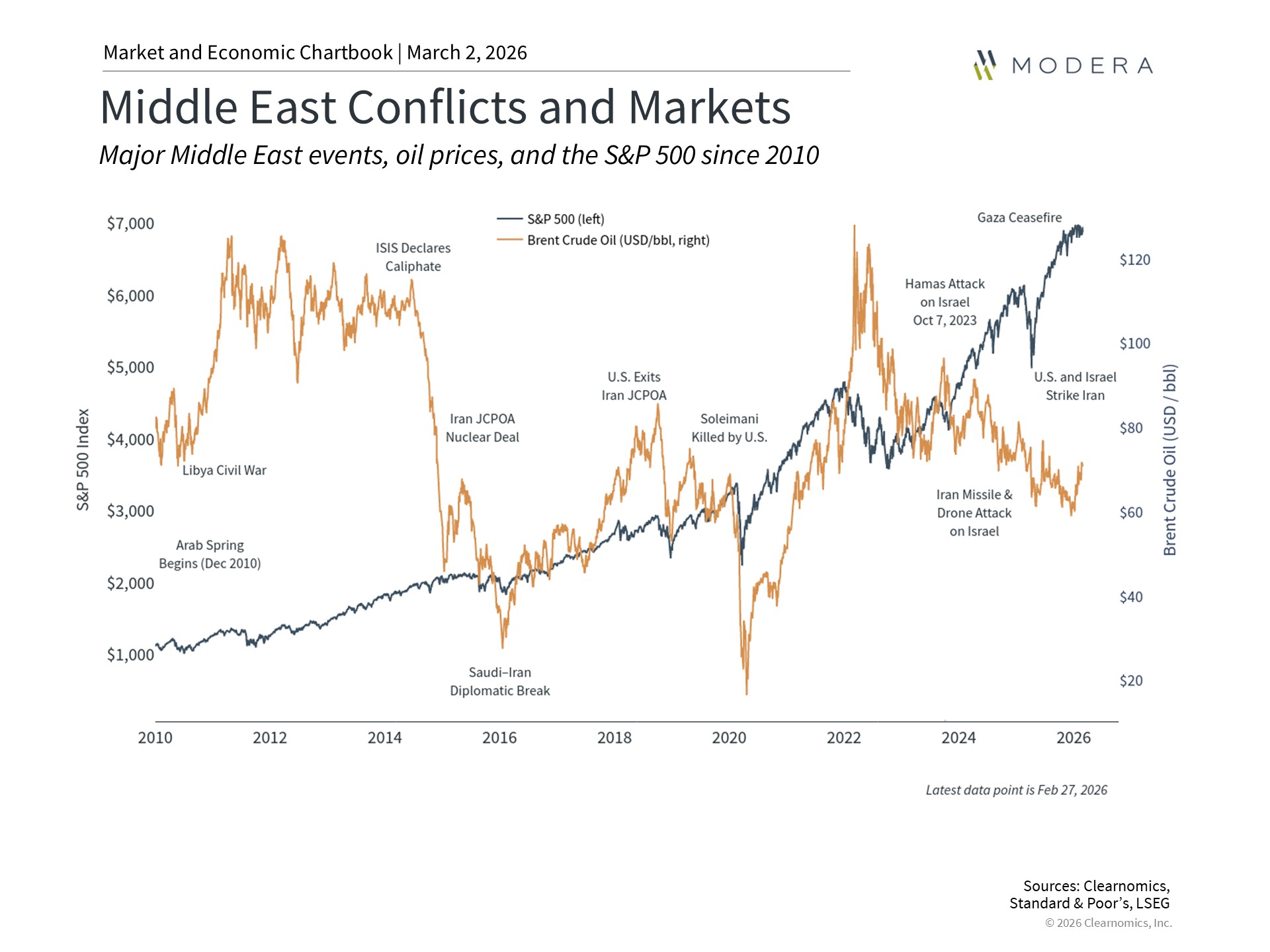
We are still in the early stages and will have to wait and see what develops to have greater clarity in the situation and its effects on the economy. But even with oil prices rising to $82 for Brent crude (and subsequently retreating to around $79 as of this writing), that is well below the 2022 peak of nearly $128 per barrel when Russia invaded Ukraine. In 2018, the U.S. also became the world’s largest producer of oil and natural gas, with current domestic production exceeding other major producers such as Saudi Arabia and Russia. While the U.S. still relies on global energy markets, this level of production helps insulate the domestic economy from supply disruptions.
The graph below charts the relationship of oil prices to the S&P 500 throughout previous conflicts. While the scale of the current strikes is significant, tensions between the U.S., Israel, and Iran have been escalating for some time. The scope of the latest strikes, including the targeting of Iran’s senior leadership, is broader than previous engagements. However, history also makes it clear that these conflicts themselves are not always a catalyst for market movements.
 In general, markets are digesting the news in a fairly restrained and predictable manner thus far. However, any sustained increase in oil prices could have implications for inflation and affect the Federal Reserve’s decisions on short term rates, putting future cuts in question. As for portfolios, we are experiencing the type of volatility we expect in markets and are prepared to weather, thanks to our diversified approach to both equity and fixed income allocations. Our allocations to Treasury Inflation-Protected Securities (TIPS) help hedge against unexpected inflation, and our shorter-than-average duration protects against price declines when yields are rising.
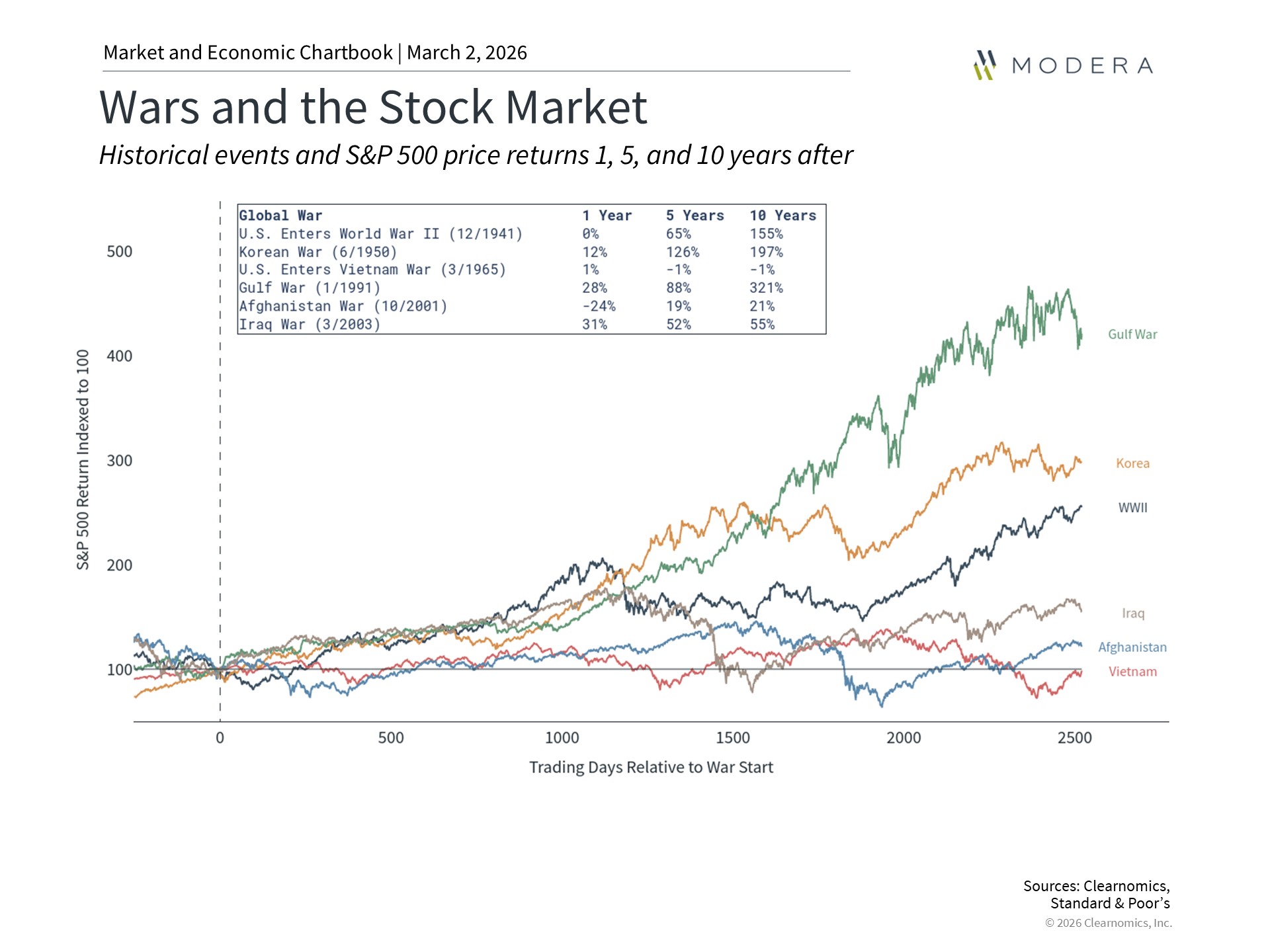
When headlines overwhelm us with anxiety over issues we are unable to control, we may want to exert control over our investment portfolios, thinking that surely there’s something we should be doing. The accompanying chart makes clear that markets have navigated even the most serious global events. From World War II to the Gulf War, to the wars in Iraq and Afghanistan, markets experienced short-term volatility but were driven by economic fundamentals over the long run. More recently, the conflicts between Russia and Ukraine, and between Israel and Hamas, created uncertainty but did not derail the broader market trajectory.
Markets may experience volatility in the coming days and weeks as the situation unfolds. Oil prices could rise further, and uncertainty could weigh on investor sentiment. But trying to time these moves would be counterproductive. Historically, markets have shown that they can rebound unexpectedly, and missing even a few of the best trading days can significantly reduce long-term returns.
As always, we will continue to monitor the situation and our clients’ portfolios. Should opportunities for trading, rebalancing, or tax loss harvesting present themselves, we will be ready to engage. As always, if your personal financial situation warrants a review of your portfolio, please reach out to your advisor. Thank you for placing your trust in Modera.
