
Many of us are given the opportunity to contribute to our retirement savings through our employers’ 401(k), 403(b) or other plans. Hopefully, you are taking full advantage of this benefit. If you are, why not take the time to check in on your retirement plan contributions and make certain you make the most of your plan and are on track with your savings goals for the year?
Are you maxing out your contributions?
In 2024, the contribution limit for anyone under 50 was $23,000. The 2025 employee contribution limit is $23,500. Also, if you are at least 50 years of age, you can contribute an extra $7,500 on top of this as part of an annual “catch-up contribution.” As a result of the SECURE 2.0 Act, an exciting “super catch-up” opportunity will be available in 2025 for employees aged 60-63. This new provision allows individuals in this age group to contribute up to $11,250 in catch-up contributions, compared to the previous limit of $7,500. Important to note, starting in 2026, if you earn more than $145,000 in the prior calendar year, all catch-up contributions at age 50 or older will need to be made to a Roth account in after-tax dollars.[1]
Consider increasing your contributions to account for this year’s contribution limit increase. Your paystub should tell you what you are contributing so you can evaluate if you will maximize your contributions by the end of the year.
Why max out contributions?
Saving for retirement is so important. If you do not have the ability within your cash flow to max out your contributions, consider adjusting your budget elsewhere to allow you to increase your contributions. Any increase to your savings will have an impact, especially with the power of compounding interest. The earlier you can start saving the better. See the chart below for an illustrative example on the power of compounding interest and the benefits of saving as early as you can.
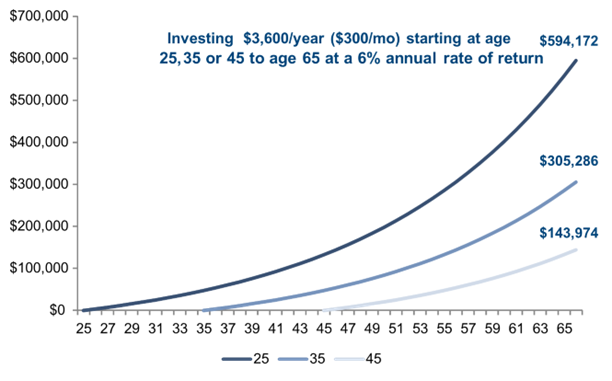
Projections are based on assumptions provided by the advisor and are not guaranteed. Actual results will vary, perhaps to a significant degree. The projections are hypothetical in nature and for illustrative purposes only and do not account for fee deductions, commissions and other expenses associated with investing.
Tips to max out contributions.
Some 401(k) plans allow you to deposit a bonus directly into your account. This is a great way to boost your retirement savings without cutting deeper into your regular paycheck.
There is also a more immediate benefit to stashing more cash into your 401(k) plan throughout the year. If you are contributing on a pre-tax basis in 2025, you are also lowering your 2025 taxable income. That means a smaller tax bill when you file your income tax return. Of course, if you are saving on a pre-tax basis, you will pay taxes when you withdraw money from the account in retirement. If you want to avoid the tax in retirement and pay it now, you can contribute to a Roth 401(k) if your employer offers that option.
Ok, I have maxed out my 401(k), now what?
If you have additional money, you may be able to save towards retirement with these other plans:
- Roth IRA
- Traditional IRA
- HSA
If you have any questions at all regarding your investments and elections, please do not hesitate to reach out to Modera. We are happy to help.